Showing posts with label chemistry. Show all posts

Reaction Between Ethanoic Acid and Sodium Hydroxide

Carboxylic acids are those containing the “oic acid ending” and looking at these molecules you’ll realize a similarity in terms of carbon to oxygen and hydrogen bonds. All carboxylic have the “COOH” group attached to their molecules. One such good example of a carboxylic acid is ethanoic acid:
CH3COOH

Sodium hydroxide is a metal hydroxide having the formula:
NaOH

If you have already done reactions involving acids and metal hydroxides you should probably already know the product that should be formed between these two.
When an acid reacts with a metal hydroxide the type of reaction that takes place is one of a neutralization reaction where the hydrogen ions are removed from the acid molecule and reacts with the hydroxide ions of the metal hydroxide. A salt and water will be the products of your reaction. The ionic equation below shows the reaction:
H+(aq) + OH-(aq) ==> H2O(l)

In this case the acid would be ethanoic acid and the metal hydroxide would be sodium hydroxide. Therefore it also follows that a neutralization reaction will take place between the ethanoic acid and the sodium hydroxide. The hydrogen ion will be removed from the ethanoic acid and replaced by the sodium metal forming a salt of a carboxylic acid known as sodium ethanoate. The hydrogen will then react with the hydroxide ions from the NaOH to form water. Since it’s a neutralization reaction no colour will be observed in the solution. The full equation for the reaction is:
CH3COOH + NaOH ==> CH3COONa + H2O
(you could also use the ionic equation given above)
Or in words:
Ethanoic acid + Sodium Hydroxide ==> Sodium Ethanoate + Water

This equation will also be useful when testing for carboxylic acids using ethanoic acid as a typical one. You’ll realize that the strong smell/odor from the ethanoic acid will be gone when reacted with sodium hydroxide because it forms a neutrilisation reaction with the NaOH.

Tollens Silver Mirror Test for Aldehydes: Experiment

Before we get into the details of this experiment lets first start by having a look at aldehydes and ketones.

a Ketone
Aldehydes and ketones are members of the same type of compound known as carbonyl compounds. Carbonyl compounds are those that have carbon to oxygen double bonds attached. In ketones the molecule is normally arranged so that the carbon to oxygen double bond can be the first thing seen on the molecule (usually in the middle).


an Aldehyde
Aldehydes on the other hand have hydrogen attached to the carbon to oxygen double bond. It is this hydrogen that accounts for the difference between aldehydes and ketones. Also it is important to note that this hydrogen is what makes an aldehyde such a great reducing agent and thus can be oxidized easily. Ketones are however resistant to oxidation meaning they aren’t that easily oxidized. When an aldehyde is oxidized in an acidic environment a carboxylic acid will be formed but when oxidized in an alkaline environment a salt of a carboxylic acid will be formed. Try to remember these facts because it is this difference that this entire experiment is based upon. Also Tollen's reagent comprises diamminesilver (i) ion which is an oxidizing agent, the formula for diamminesilver (i) ion is:
[Ag (NH3)2]+

Title of Lab/Experiment: Tollens Test

Aim of Lab/Experiment: Using Tollens reagent to distinguish Aldehydes from ketones.

Things you’ll need:

  • silver nitrate solution
  • Dilute ammonia
  • Glucose (Aldehyde)
  • Acetone (Ketone)
  • Distilled Water
  • Test Tube
  • Bunsen Burner
Tollens apparatus

Procedure:

  1. Accurately measure out 3ml of silver nitrate solution and place in a clean test tube, then using the dropper add dilute ammonia to the test tube drop by drop until no precipitate is left. Add another 5ml of ammonia to the test tube.
  2. Accurately measure 4g of glucose and place in a beaker, after which you’ll measure 10ml of distilled water and place in the beaker as well.
  3. Pour the contents of the beaker and the test tube in a large boiling tube.
  4. Immerse the boiling tube into water at 75 degrees. Record observations in a suitable table.
  5. Repeat the above procedures using acetone instead of glucose.


Results:


Table Showing Results Obtained From Tollens Test

Glucose(Aldehyde)
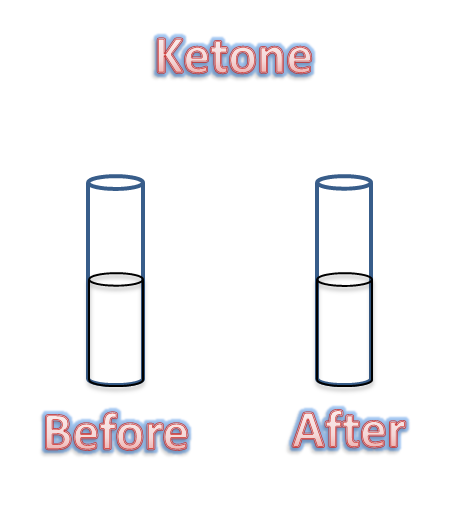
Acetone(Ketone)
Observations
After a few hours the colorless solution formed a silver mirror in the boiling tube.

No change took place. The solution remained colorless.


Interpretation of what happened

The diamminesilver ion was reduced to metal silver while the aldehyde in turn was oxidized to a carboxylic acid (gluconic acid).

Because the acetone is a ketone it wasn’t oxidized and therefore didn’t do any reducing.


The equation for the overall reaction of the aldehyde and the diamminesilver is:

RCHO + 2[Ag(NH3)2]++ 2OH- ---> RCOOH + 2Ag + H2O


Co-ordinate/ Dative Covalent Bonding

What is Co-ordinate Bonding?

You may have learned about covalent bonding which involves both atoms sharing a pair of electrons; however this is not the case for coordinate bonding. By definition coordinate bonding is a form of covalent bonding in which only one of the atoms share the pair of electrons while the other doesn’t.

Examples of coordinate bonding:
  • In the reaction between ammonia and hydrogen chloride a coordinate bond takes place forming solid ammonium chloride. 
                            NH3 + HCl  ----->  NH4 Cl


    In this reaction the hydrogen ion from the hydrogen chloride leaves its electrons and gets transferred to the lone pair of electrons on the ammonia molecule forming ammonium ions(NH4 +). This is known as a coordinate bonding. Seeing that the hydrogen has left its electrons the chloride will therefore have a negative charge while the ammonium will have a positive charge. The diagram below shows the reaction:


    Coordinate bonds are usually represented by using a diagram similar to the one below, the arrow usually points from the atom donating the lone pair to the atom accepting it.


    • Another example would be the reaction between ammonia and boron trifluoride. Boron trifluoride is said to be electron deficient meaning it has 3 pairs of electrons at its bonding level but it is capable of having four pairs. In this reaction the ammonia is used to supply this extra lone pair. A coordinate bond is formed where the lone pair from the nitrogen moves toward the boron. The end containing the nitrogen will therefore become more positive while the boron end will become more negative because it has received electrons.

    Resources:

    Read more on coordinate bonding at chemguide


    Spontaneous Fission

    Spontaneous Fission is a form of radioactive decay in which the original nucleus divides or splits into smaller nuclei. This usually involves the ejection of one or more electrons. Spontaneous fission is said to be a very slow process for lighter isotopes. It is a characteristic of very heavy isotopes.

    An example of spontaneous fission is shown below:


    (Note for more detailed explanation please visit here)

    Radiation: Alpha, Beta & Gamma Decay

    Radioactivity can be defined as the spontaneous emission of radiation from an atom having unstable nuclei or as a result of a nuclear reaction.

    There are three types of radiation that are covered in this topic:

    1. Alpha Decay(α)
    2. Beta Decay(β)
    3. Gamma Decay(γ)


    Alpha Decay


    An Alpha particle has the same mass number and atomic number as Helium and is said to be the same as the Helium-4 nucleus. Usually most heavy elements emit alpha particles. When an atom undergoes this form of decay its mass number will decrease by 4 while its atomic number decreases by 2.

    For example:


    Beta Decay
    • Electron Emission: - As the term suggests, this is when an electron gets emitted from the nucleus, this usually results in the charge in the nucleus increasing by one.

    An example of how to calculate Beta Decay is given below:


    Gamma Decay


    This usually occurs after alpha decay has taken place. This is as a result of the excess energy produced by the alpha particle; this energy is released when the gamma-ray is emitted from the nucleus. Usually no chemical change occurs when an atom emits gamma-ray because it has neither charge nor mass. Gamma-rays are also delayed, short-lived and metastable (m).

    Example:

    Structure of Atoms, Mass Number and Isotopes

    The atom comprises protons, neutrons and electrons. The protons and neutrons are enclosed in a central nucleus that is at the center of the atom, together they are collectively known as nucleons. All of the mass of an atom is said to be in the nucleus because electrons weigh little.

    The table below shows some comparisons between protons, neutrons and electrons:


    Sub-atomic particle
    Relative Mass
    Relative Charge
    Proton
    1
    +1
    Neutron
    1
    0
    Electron
    1/1836
    -1


    Calculations:


    Finding protons, neutrons or mass number:-
    Given the values of two of these variables one can transpose the following formula to find the third variable.

         Mass # (A) = # of protons (z) + # of neutrons
    Note: The names may vary for e.g. number of protons can sometimes be called atomic number and mass number can be called nucleon number.

    For example calculate the number of neutrons in this atom:


    If you look at the diagram closely you will see that they have given you two value the mass number and the number of protons (in this example the term atomic number is used instead). Right away one can see that all is needed is to transpose the previous formula to find number of neutrons.

        Mass number = number of protons or atomic number + number of neutrons
                                                        
                 19          =         9     +      N


    When done transposing this formula for N you should get:

                          19 – 9 = 9 – 9 + N
                          19 – 9 = 0 + N
                                10 = N
                             =>N = 10

    Finding the number of electrons:-


    It is relatively easy to find the number of electrons because no calculation is needed. Atoms are neutral the positive charges from the protons will balance the negative charges of the electrons. Therefore the electrons would have to be the same number as that of the protons.
         Number of protons = Number of electrons.

    Isotopes:
    These are atoms of the same element with the same atomic number but different mass numbers. This is due to a difference in the amount of neutrons present in each atom; the protons however do not change. For example there are three isotopes of carbon namely: Carbon-12, Carbon-13 and carbon-14(the numbers represent mass) their protons remain the same being 6 but the neutrons vary being 6, 7 and 8 respectively.

    Relative Atomic Mass:
    The relative atomic mass of an element can be defined as the ratio of the mass of an atom of the element to one twelfth the mass of carbon-12.

    The relative atomic mass can be found using the following formula:

         R.A.M = Mass of one atom of the element   × 12
                         Mass of one atom of Carbon-12

    Process of Theoretical Change: Dalton’s Atomic Theory

    Over centuries many theories were developed but today only a few remain valid. One of the most “talked-about” theories was the one made by John Dalton, a physicist, meteorologist and a chemist. One of the main reasons why his work is so popular today is because some of his discoveries have helped in the development of the modern atomic theory. There are however cases were his theory is a little different from modern theories.

    John Daltons Theory Stated that:
    1. All matter is made up of atoms.
    2. Atoms are indestructible and indivisible.
    3. Atoms of the same element have identical properties and mass.
    4. A chemical reaction is a rearrangement of atoms.
    5. A compound is formed by a combination of two or more different kinds of atoms.

      Cases where Daltons Theory is different:

      • John Dalton’s theory stated that atoms of the same element have identical masses but modern theories have proved that atoms of the same element can have different masses, these atoms are called isotopes however they do have the same chemical properties.
      • In modern research it was discovered that atoms can be destroyed by nuclear reactions but not by chemical reactions.
      The following table summarizes the changes in theories over time:

      Name Discovery/Theory
      Democritus, 460 BC    Came up with the idea of atoms
      John Dalton, 1808 After the idea of atoms was dismissed for over 2000 years, he reintroduced the idea of atoms and through many experiments he proved the existence of atoms.
      Joseph .J.Thompson, 1898 Stated that positively charged substances were distributed uniformly over the surface of the atom containing electrons embedded within them.
      Ernest Rutherford, 1910 From J.Thompson’s model and through his own experiments he was able to determine the true model of the atom. Instead of the positively charged particles being distributed over the atom they were gathered together in the nucleus.
      Niels Bohr, 1913
      He came up with these rules:
      1. Electrons can only orbit a fixed distance from the nucleus.
      2. Atoms lose energy when electrons go from higher energy to lower energy orbits and the opposite happens from lower energy to higher energy orbits.
      Wolfgang Pauli, 1924 Stated that electrons spin while orbiting the nucleus. He also came up with his own principle known as the Pauli Exclusion Principle which stated that no two electrons of a given atom can have the same set of quantum numbers.

      Common Chemical reagents used in chemistry

      Common chemical reagents used in chemistry

      Acetone (propanone) : An inflammable organic solvent used in extractions.

      Acetic Orcein: Biological reagent, stains root tip( used in the observation of mitosis).

      Agar( nutrient ): Complex sugar extracted from red algae and used to solidify a bacterial medium.

      Alcohol( ethanol/ methylated spirits): Used to decolourize leaves in photosynthesis  experiments; used along with cold water, in the emulsion test for the ppresents of lipids(fats). A clody white suspension indicates a positive test result; this substance is flammable.

      Ammonia solution:  Used in qualitative analysis experiments to detect the presence of some cautions.

      Aniline Hydrochloride: Biological reagent, lignin(wood) stains yellow.

      Barium chloride / nitrate: Reagents used in qualitative analysis to detect some cautions in solution.

      Benedict's solution/ Fhehling's solution: Tests for simple or reducing sugars like glucose. A change in color from blue to green to yellowish to red is seen. A red precipitate is formed.

      Bicarbonate indicator solution: Used in photosynthesis and respiration experiments. It identifies changes in CO2 concentration.

      Biuret reagent: Used in biurette test for the presents of proteins. A purple color indicates a positive test result.

      Borax carmine: Biological reagent, used to stain mounts of animal material. Nuclei stain pink.

      Bromothymol Blue solution:  pH indicator (range 6.0 to 7.6); Used in respiration experiments; it turns from blue to yellow or green, if CO2 is present.

      Bromine: A bown toxic gas. It is used to demonstrate diffusion of gases. It is used as a bench reagent in chemistry.

      Calcium Chloride: A drying agent used in dessicators.


      Interested in more Chemistry Science notes?

      Rates of Reactions questions and answers

      Here are some free rate of reaction questions and answers.

      1.  How does a catalyst speeds up a reaction?
      2. Does increasing the concentration of a reaction Always increases the rate of the reaction?
      3. Where would the Maxwell-Boltzmann Distribution shift if temperature increases, to the right or to the left?
      4. Reactions occur in a series of steps called?
      5. What is the overall order of a reaction?
      6. Does catalyst increase speed of reactants?
      7. A energy profile diagram shows the products have more energy than reactants. What kind of reaction is this?
      8. In a zero order reaction what is the shape of the graph is it curved or straight?


      Answers:

      1. By lowering the activation energy.
      2. No increasing the concentration of a reaction does not always increase the rate of the reaction.
      3. To the right.
      4.  Mechanism.
      5. This is the sum  of the order of the reactants.
      6. No.
      7. Endothermic.
      8. The shape of the graph is straight.


      Interested in more Chemistry Science notes ?

        The different states of matter

        There are three states of matter:
        1. Solid
        2. Liquid
        3. Gas
        Solid
        • The particles of solids are very tightly packed
        • They posses a definite shape and volume
        • Have unlimited number free space
        Liquid

        • Particles are slightly packed. They can move more freely than solids but not more than gases.
        • They have define volume but indefinite shape
        • They have one free space
        Gas

        • Particles are very far apart.
        • They move freely
        • They have indefinite shape and volume
        • No free spaces present

        Understanding the rate of a reaction

        The rate of a reaction is not how much of products are formed nor how much of reactants disappears but rather how fast the reaction takes place.

        For a reaction to take place there are certain conditions that must occur:
        • The particles must collide with enough energy for bonds to break.
        • The particles must be properly orientated.
        The speed of a reaction can be found in a number of ways:


        1. By measuring the time a certain amount of product is formed
        2. By measuring the time taken for a reactant to disappear.
        Factors affecting the rate of a reaction:
        • Concentration
        • Particle size
        • Pressure
        Concentration:- Increasing the concentration of a reaction increases the rate of the reaction.

        Particle size: - The smaller the particle the faster the rate of the reaction.

        Pressure:- Like concentration increasing the pressure increases the rate of the reaction but its usually for gases.

        Intermolecular attractions Vs Intramolecular attractions

        Forces of attraction which holds an individual molecule together is known as Intramolecular attractions while intermolecular forces of attractions are between neighboring molecules.


        Please note: All molecules experience intermolecular attractions

        The Nucleus

        At the center of an atom is the nucleus. The nucleus contains the nucleons which are the protons and neutrons. Because most of the weight of an atom comes from the nucleus, electrons can be said to weigh little.

        The formula for finding out the number of protons and neutrons is:

        Mass number (A) = Number of protons + number of neutrons


        Some common comparisons:
        Number of protons = Atomic number
        Mass number = Nucleon Number